Guru Nanak College (Autonomous), Chennai
A Sikh Minority Institution
A Sikh Minority Institution
To be a focal point for imbibing the best educational practices to provide an improved academic environment for the present and future students of Guru Nanak College.
The Office of the Dean Academics is dedicated to:
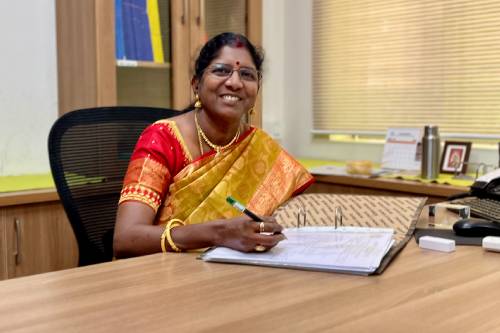
| S. No | Name | |
|---|---|---|
| 1. | Dr. K.P. Sanjayan | 2015 to 2018 |
| 2. | Dr. Suresh George | 2018 to 2020 |
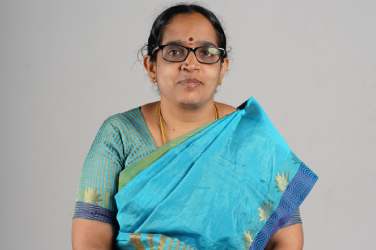
| 3. | Dr. S. Savithri | 2020 to 2023 |
| 4. | Dr. Hansa Lysander Manohar | 2023 to 2024 |
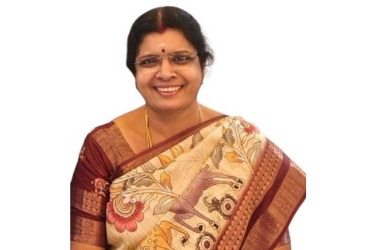
| 5. | Dr. Swati Paliwal | 2024 to 2026 |
| 6. | Dr. T.K. Avvai Kothai | 2026 Onwards |


The Office of the Dean Academics and the Intellectual Property Rights Cell of our college, took a significant step towards India’s vision of Viksit Bharat 2047 by organising a Two-Day National Conference on Integrating Indian Knowledge Systems and Innovation: Roadmap to Viksit Bharat 2047 (IKS-VB 2026) on January 22 and 23. The conference featured six interdisciplinary thematic tracks and witnessed an overwhelming response with 497 registrations and 67 paper presentations, conducted in both online and offline modes. The inaugural session included addresses by the Principal, Dr R M Ezhilarasi, and the Convener, Dr Swati Paliwal, who highlighted the relevance of Indian Knowledge Systems (IKS) in higher education and research. Following which the Conference Book of Abstracts, containing 234 abstracts, was released.
The session featured a Special Address by Dr J Radhakrishnan, IAS, Additional Chief Secretary to Government and Chairman and Managing Director, TNEB & TNPDCL, Government of Tamil Nadu, who underscored the urgency of integrating India’s traditional knowledge systems with modern scientific and technological frameworks. Prof Pandit Bhalchandra Vidyasagar, Former Vice Chancellor, Swami Ramanand Teerth Marathwada University, Maharashtra’s keynote address focused on integrating IKS into contemporary education in line with NEP 2020 and advocated holistic, experiential and interdisciplinary learning. The Inaugural Address by the Chief Guest, Prof M Krishnan, Vice Chancellor, Central University of Tamil Nadu, Thiruvarur, highlighted the civilisational roots of Indian Knowledge Systems and stressed the role of higher education in addressing societal and local challenges through indigenous wisdom.
The academic proceedings on Day 1 included Technical Session I on Indian Knowledge Systems and Intellectual Property Rights by Dr D K Hari and Dr D K Hema Hari, Founders, Bharath Gyan, followed by Technical Session II featuring paper presentations under Science and Engineering and Technology. Day 2 included Technical Session III with presentations under Commerce and Management and Law, and Technical Session IV focusing on Social Sciences, Languages and Multidisciplinary Studies.
The valedictory session commenced with Tamil Thai Vazhthu and a Welcome Address by Dr P V Kumaraguru, Vice Principal. The Conference Report was presented by Dr Mahendrakumar M, Organising Secretary and Coordinator, IPR Cell, summarising the academic deliberations of the two-day conference. The Valedictory Address was delivered by the Chief Guest, Prof Santishree Dhulipudi Pandit, Vice-Chancellor, Jawaharlal Nehru University, New Delhi, who spoke on the civilisational foundations of Indian Knowledge Systems, the challenges of curriculum integration, and the need to decolonise academic mindsets.
In his Special Address, Mr Manjit Singh Nayar, General Secretary and Correspondent, highlighted the global relevance of Indian Knowledge Systems and emphasised the importance of integrating indigenous wisdom with innovation for national development. The Guest of Honour, Prof. N. Panchanatham, Vice Chancellor, Gandhigram Rural Institute, Tamil Nadu, described the conference theme as timely and stressed the enduring relevance of Indian Knowledge Systems in India’s intellectual and cultural framework.
The conference concluded with a vote of thanks by Dr Swati Paliwal, Convener of the conference, expressing gratitude to all dignitaries, speakers, participants and the organising team for making the event a meaningful academic endeavour.
A Sikh Minority Institution | Unit of Guru Nanak Educational Society (Regd.)
Affiliated to University of Madras | Approved by AICTE
Accredited at "A++" Grade by NAAC
Guru Nanak Salai, Velachery, Chennai - 600042.
Tel: 044-2245 1746, 044-2244 4621
E-mail: principal@gurunanakcollege.edu.in